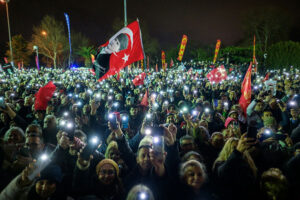
Thousands gather outside Istanbul City Hall to mark one year since the arrest of Mayor Ekrem İmamoğlu on 18 March 2026. Credit: Yasin Akgul/AFP
By Inés M. Pousadela
MONTEVIDEO, Uruguay, Jun 15 2026 – When Hungary’s Prime Minister Viktor Orbán lost by a landslide to a unified opposition in April, Turkey’s President Recep Tayyip Erdoğan was watching. The lesson he drew was not that he should be more moderate; it was that he needed to crack down harder. He had already arrested Istanbul Mayor Ekrem İmamoğlu, the opposition Republican People’s Party (CHP)’s leading presidential contender, in March 2025. After Orbán’s defeat, he has accelerated his campaign to fracture the opposition and rewrite the rules before the next election in 2028.
Electoral autocracy
Erdoğan has been in power since 2003. After surviving a coup attempt in July 2016, he used emergency powers to purge the state at scale. Over 150,000 people were detained, fired or suspended from their jobs. Emergency decrees expanded the government’s power to shut down organisations and remove elected officials. A 2017 constitutional referendum, narrowly approved in a campaign that independent observers found deeply flawed, replaced Turkey’s parliamentary system with a hyper-presidential one.
Independent media has been systematically dismantled. Turkey now ranks 163rd out of 180 countries on Reporters Without Borders’ 2026 World Press Freedom Index. Yet elections have continued, and the opposition has continued to win at the municipal level, most strikingly in Istanbul in 2019 and again by an even wider margin in 2024. That residual competitiveness is what Erdoğan is now moving to close.
İmamoğlu had beaten Erdoğan’s candidate in Istanbul twice, was formally nominated as the CHP’s 2028 presidential candidate and polled strongly against Erdoğan nationally. Authorities arrested him on charges of corruption and links with terrorism as his nomination was under way, triggering Turkey’s largest wave of protests in over a decade. A 4,000-page indictment filed in November 2025 sought to sentence him to over 2,000 years in prison. Espionage charges followed in February 2026. His trial began in March amid continuing protests. He remains in prison, and in the 14 months since his arrest, over 500 more people have been detained, including 16 CHP-affiliated mayors.
With İmamoğlu imprisoned, Erdoğan’s next move was to prevent the CHP from consolidating around anyone else. On 21 May, an appeals court annulled the outcomes of the CHP’s 2023 national congress, ejecting the party’s elected leader Özgür Özel, who had raised the CHP to rough parity with Erdoğan’s Justice and Development Party (AKP) in national polls, and reinstating his predecessor Kemal Kılıçdaroğlu, a divisive figure who lost the last presidential election. Özel condemned the ruling as a judicial coup and refused to leave the party’s headquarters. Three days later, riot police stormed in, firing rubber bullets and teargas. The government denied any involvement, implausibly claiming the judiciary had acted independently. The operation was legal in form and political in substance.
Turkey’s constitution limits presidents to two five-year terms, and Erdoğan’s second expires in 2028. In May 2025, he appointed a legal team to draft a new constitution. It seems clear the goal is to extend his eligibility. The AKP and its nationalist allies fall short of the parliamentary threshold required to change the constitution or call a referendum on it. Some analysts believe the government’s recent initiative to end the decades-long conflict with the Kurdistan Workers’ Party is at least partly designed to attract enough parliamentary votes to clear that threshold.
There is a structural reason the stakes are so high. Turkey’s hyper-presidential system means that, unlike Orbán, Erdoğan would have no safe path back from electoral defeat. For him, losing power could mean political extinction. His crackdown is a response to this threat.
Civil society resistance
Turkey’s civil society has, however, not submitted. Huge protests followed İmamoğlu’s arrest. A mass rally marked his 100th day in jail, and people marched again when the CHP headquarters were raided. Most recently, when Erdoğan ordered the closure of Bilgi University, one of Turkey’s oldest liberal academic institutions, students and staff immediately gathered outside to protest. Within two days the government reversed the closure. This illustrated both the extent of Erdoğan’s repressive urges and their limits when met with swift resistance.
The government has responded to protest with blanket bans on public gatherings, social media restrictions and mass arrests. Four days after İmamoğlu’s arrest, at least 1,879 people had been detained. Police repeatedly intervened forcefully, using teargas and detaining protesters and journalists.
Orbán’s downfall has frightened Erdoğan as much as it has inspired the Turkish opposition. He is moving to eliminate the conditions that made it possible. He has got rid of the most credible and unifying opposition candidate, neutralised the main opposition party and is in the process of dismantling what’s left of an electoral architecture that, however tilted, could still allow the opposition to win.
Turkey’s democracy now depends on whether enough people keep showing up, and on whether they can keep resisting Erdoğan’s campaign to dismantle democracy.
Inés M. Pousadela is CIVICUS Head of Research and Analysis, co-director and writer for CIVICUS Lens and co-author of the State of Civil Society Report. She is also a Professor of Comparative Politics at Universidad ORT Uruguay.
For interviews or more information, please contact [email protected]
!function(d,s,id){var js,fjs=d.getElementsByTagName(s)[0],p=/^http:/.test(d.location)?’http’:’https’;if(!d.getElementById(id)){js=d.createElement(s);js.id=id;js.src=p+’://platform.twitter.com/widgets.js’;fjs.parentNode.insertBefore(js,fjs);}}(document, ‘script’, ‘twitter-wjs’);